



What’s the first rule in scuba diving? That’s right: look cool. (And don’t hold your breath, either!)
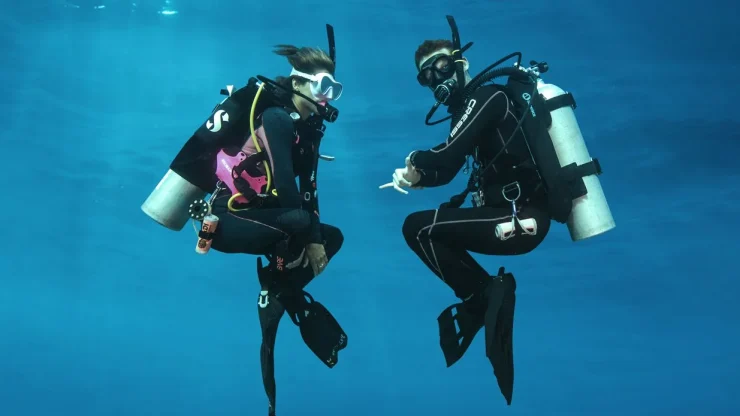
Neutral buoyancy is that magical moment when you stop fighting the ocean… and the ocean stops pushing you around. You’re not finning to stay off the bottom. You’re not bobbing up like a cork. And you look like your guide: pretty cool.
You’re just there, hovering, breathing, watching, and actually enjoying the dive.
Buoyancy while scuba diving isn’t just a “nice-to-have” skill. It’s your comfort, your air consumption, your reef etiquette, and your safety wrapped into one. It also makes you look ridiculously cool, which I won’t pretend doesn’t matter.

Buoyancy basics without the headache
When scuba diving, neutral buoyancy isn’t “set it and forget it.” It’s a moving target because your depth changes, your wetsuit compresses, your tank gets lighter, and your breathing rhythm shifts. Your job is to stay ahead of those changes instead of reacting like a yo-yo.
Neutral, Positive, Negative: What’s what?
- Positively buoyant: you float up.
- Negatively buoyant: you sink down.
- Neutrally buoyant: you hover at a stable depth with minimal effort.
The tiny bit of physics that actually helps understand buoyancy in Scuba diving
Archimedes’ principle says an object in a fluid gets an upward push equal to the weight of the water it displaces.
In diver language: change your volume, change your buoyancy.
That’s why, adding air to your BCD makes you rise, neoprene compression at depth makes you less buoyant,
inhaling slightly lifts you, exhaling slightly drops you down.
Simple. Powerful. Annoying when you’re new. Brilliant once it clicks.

Why is neutral buoyancy important, and how it can change your diving
Longer bottom time (Yes, really!)
When you’re over-weighted and constantly kicking to stay level, you burn gas. When you’re streamlined and calm, your breathing settles and your air lasts longer. Less effort, lower stress. That’s not marketing. It’s physiology!
Calm, control, and better buddy skills
Ever tried to help a buddy while you’re flapping like a flag in the current? Not fun. Good buoyancy makes everything easier: mask clears, SMB deployment, navigation checks, sharing air, holding a safety stop without grabbing a rock. In dive sites like Gordo Banks, with current and depth, good buoyancy will help you have better and safer shark interactions.
Reef-friendly diving that looks good
Maintaining a proper buoyancy helps you become a more ocean-friendly diver!
In Cabo Pulmo National Park, diver behaviour is taken seriously. As a dive guide, I’ve seen the difference between a diver who hovers… and a diver who “kneels and bulldozes.” The ocean remembers. So do the park rangers.
Safety: Stops, Ascents, and Staying out of trouble
Poor buoyancy can lead to uncontrolled ascents, missed stops, and stress spirals. It’s one of the biggest “quiet” safety skills in diving. Solid buoyancy control supports:
- Controlled descents,
- Stable depth,
- Slow, tidy ascents,
- Calm safety stops.
Improve your underwater photography
Want sharp images? The secret weapon for underwater photography: you need stability.
Neutral buoyancy lets you hold position without sculling your hands or finning the sand into a brown-out.
Whether you’re framing a shy little critter or waiting for the perfect angle, buoyancy is the difference between “almost” and “nailed it.”

Weight and trim for perfect buoyancy: The foundations most divers skip!
Do your buoyancy check, and make sure that you are properly weighted.
A buoyancy check is your quick “weight reality check” before you go chasing perfect trim. Do a weight check at the start of a trip and anytime your exposure suit, tank, or gear setup changes!
- Too much weight causes unnecessary effort.
- Too little weight can prevent descent.
How to do a proper weight check?
Fully geared up, BCD empty, you should float at eye level on a normal breath, then slowly sink as you exhale. Nail this and you’ll descend easily, hover calmly, and waste far less air.
The gold-standard check is with a near-empty tank (around 50 bar / 700 psi). That’s the moment you’re most likely to float up.
Adjust your trim to maintain a good underwater posture
Trim is your posture in the water. The goal is usually horizontal and streamlined: knees slightly bent, fins up, chest relaxed, head neutral.
If you’re head-up/feet-down, you create drag and you’ll fin harder. If your fins hang low, you’ll kick the bottom, disturb silt, and start that whole frantic buoyancy correction cycle. Tiny changes make big differences!
Weight placement for better trim!
- If your feet drop: move weight up (trim pockets, tank band, slightly higher tank position).
- If your head drops: move weight down (hips, belt position).

Diving gear choices that makes buoyancy easier
BCD Style and Fit
It’s no coincidence that BCD stands for Buoyancy Control Device! A Jacket, back-inflate, wing-style… they can all work and will help you to achieve a perfect neutral buoyancy. What matters most:
- BCD fit: No riding up, no squeezing
- Easy air dumping: You can vent from different positions
- Trim options: Tank strap placement, trim pockets if needed.
Integrated Weights vs Belt Weights
As we saw before, proper weighting is a huge matter in buoyancy control. Use what you’re confident with. The best system is the one you can manage calmly.
- Integrated weight systems feel tidy and comfortable.
- Weight Belts are simple and often easier to ditch quickly.
Negative or Buoyant Fins paired with the correct boot
Forget ankle weights! If you have floaty legs and you have to also wear a 7mm suit, why not rent some of our CRESSI ORIGIN HD (High Density) fins with a pair of Converse All -Star boots. If you need to buoy up your legs, then the CRESSI ORIGIN LD (Low Density) with 5mm neoprene boots might help.
View this post on Instagram
Wetsuits and exposure protection
Diving wetsuit and exposure protection hugely affects buoyancy. The thicker the suit, the more it makes you float. Make sure you are properly weighted according to the type of wetsuit you are wearing.
Also wetsuits are made of neoprene that is naturally buoyant and compresses with depth, requiring constant adjustment. Plan for that and expect to add small amounts of air as you descend.
Keep reading: Weights and Wetsuits – A Guide to Fine-Tuning your Buoyancy
Aluminum vs Steel Tanks
Aluminum tanks get more positively buoyant as they empty. Steel tends to stay more negative. Either is fine, but your weighting must match what you’re actually diving. Ask your dive center what type of tank you are using and adjust your weighting and trim accordingly. In Cabo we dive with Aluminium 80s (12 L) or 100s (15L). If you opt for larger tanks for some deeper dives, you will need a whole new weight check!

Using Your BCD Like a Precision Tool: It is NOT a Jet Pack!
Micro-adjustments, not big bursts
Add or vent air in small taps, then wait a moment. Big blasts lead to big corrections, which leads to… you guessed it… yo-yo diving.
Descent and ascent timing
- On descent, vent early and often as your suit compresses.
- On ascent, vent before you feel buoyant, not after. Expanding air accelerates quickly.
Let your lungs do the fine work
Once you’re close to neutral, your lungs are your micro-control. That’s the “hover like a pro” trick. No drama required.
- A slightly deeper inhale lifts you a few centimetres,
- A relaxed exhale drops you back.

Breathing for perfect buoyancy control
Diaphragm breathing underwater
Think slow, deep, relaxed breaths from the belly. Calm breathing reduces CO₂ build-up and helps you stay mentally steady.
How big a difference one breath makes
A full inhale can lift you noticeably. If you’re already neutrally buoyant, you can hover over fragile reef without touching anything, simply by breathing smoothly.
How to stop overcorrecting
If you feel yourself rising and you dump air and exhale hard and fin down… you’ve just stacked three corrections. Keep it simple: one small action, then wait.
The classic mistakes (and quick fixes) about neutral buoyancy
Overweighting
You end up carrying lots of air in your BCD and wobbling around. Fix it with a proper weight check and smaller increments.
Bad trim
You fight your own posture. Fix it with tank position and weight placement.
Using the BCD for every tiny change
Use breath control once you’re close to neutral.
Erratic breathing or breath-holding: it throws everything off and it’s unsafe. Keep breathing, always.
Diving training that speeds up the learning curve of perfect buoyancy
PADI Open Water Course (2 dives add-on)
This is one of my favourite ways to level up brand-new divers quickly: Our Open Water course PLUS program with 2 extra instructor-led dives to focus on real-world skills you’ll use constantly. More buoyancy coaching. More awareness. More confidence!
PADI Open Water Course in Cabo San Lucas
PADI Peak Performance Buoyancy Specialty
If you want the most direct route to better buoyancy, this is it. In this PADI specialty you’ll work on trim, breath control, weighting tweaks, hovering, and efficient finning with targeted feedback; the kind that’s hard to self-diagnose mid-dive.
PADI Peak Performance Buoyancy in Cabo San Lucas
Your Logbook: The most underrated coaching tool
Write down what you used and how it felt. You’ll build your own buoyancy “recipe book”:
- Wetsuit thickness,
- Weight amount and placement,
- Tank type,
- Diving conditions,
- what you’d change next time.
My final thoughts on buoyancy control: The best divers look effortless
Neutral buoyancy is the skill that quietly upgrades everything: your air consumption, your comfort, your photos, your impact on the environment, and your safety. And the fun part? You don’t need years to improve it. You need the right setup, a few smart habits, and some coaching that’s tailored to you!
If you want to fast-track it in Cabo San Lucas, come dive with us at Cabo Private Guide. We’ll get you hovering like a pro!
