



Hold on there, male diver! Did you think this article is just for women? Well, don’t turn away just yet. If you work in the industry as a dive guide or captain, or if you buddy with female divers, then this is something for you too! If you dive with your wife, sister, girlfriend, daughter, aunt, friend, female client… anyone of child bearing age with a uterus, then you should read this!
Yes, I said uterus in a professional environment.
For many women, one of the first unspoken worries before a dive trip is simple: “What happens if I get my period while I’m diving?”
It’s a question that still gets whispered on dive boats and asked quietly at dive shop counters all over the world. Yet the reality is that women dive on their periods every single day — recreational divers, instructors, dive masters, underwater photographers, marine biologists and technical divers alike.
Whether it’s a weekend of diving in Cabo, a liveaboard in Indonesia, or repetitive diving during a certification course, periods are simply part of real life for many female divers.
And thankfully, for the vast majority of healthy women, menstruation is not a reason to avoid diving.
That said, diving during your period can feel different physically and emotionally, especially during long dive days, repetitive diving schedules, hot weather, or rough boat conditions. Like many aspects of diving, preparation and awareness go a long way.
As more women enter the dive industry and recreational diving community, conversations around female-specific dive health are finally becoming more open — and honestly, they need to. Because while scuba diving research has advanced enormously over the years, women’s physiology in diving is still, much like standard female medical issues, vastly under-studied.
So let’s talk about it properly: practically, honestly, and without embarrassment.
Can You Safely Dive on Your Period?
In general, yes.
There is no evidence that menstruation itself makes scuba diving unsafe for healthy women. Most women can continue diving normally during their cycle provided they feel physically well enough to do so.
Many female dive professionals work full-time in demanding dive environments while menstruating, often completing multiple dives per day in warm climates, strong currents, or physically challenging conditions. Cue 1990’s Tampax rollerskating commercial (that one’s for the Xennials)
The key consideration is usually not whether diving is “allowed” during menstruation.
It’s how your individual body feels.
Some women notice:
- Increased fatigue
- Cramps
- Lower back discomfort
- Bloating
- Changes in hydration
- Increased susceptibility to seasickness
- Mood fluctuations
- Feeling colder than usual
Others feel absolutely no difference at all.
As with so many things in diving, knowing your own body matters more than generalized assumptions.
What Does the Science Actually Say?
This is where things become a little more complicated.
Despite the large number of women actively participating in diving worldwide, there is still relatively limited research specifically examining menstruation and scuba diving physiology.
According to Divers Alert Network (DAN), some retrospective studies have suggested there may be a slightly increased incidence of decompression illness (DCI) during menstruation, particularly when combined with oral contraceptive use.
Researchers have proposed several possible explanations, including:
- Hormonal fluctuations
- Fluid retention
- Changes in circulation
- Potential differences in nitrogen elimination
However, the evidence remains inconclusive.
Most available studies are small or observational, meaning researchers are often analyzing diver reports after the fact rather than conducting large controlled clinical trials. DAN itself notes that current findings “suggest, but do not prove” an increased risk relationship between menstruation and decompression illness.
In other words, there simply is not enough high-quality research yet to make definitive claims.
And honestly, that lack of research is important to acknowledge.
Women now make up a significant percentage of the global diving population, yet female-specific diving physiology remains far less studied than general decompression theory. Many female dive professionals and dive medicine specialists continue to advocate for more research in this area.
For now, most dive medicine experts take a practical, conservative approach:
if a diver is menstruating and not feeling at their best, it may be sensible to dive slightly more conservatively.
That could include:
- Staying exceptionally hydrated
- Extending safety stops
- Avoiding pushing no-decompression limits unnecessarily
- Reducing repetitive deep dives
- Monitoring fatigue carefully
- Prioritizing rest between dives
Not because menstruation is considered dangerous underwater — but because conservative diving is always smart when the body is under any additional physiological stress
The Shark Myth

This is probably the most persistent myth surrounding women and diving.
No, diving on your period does not automatically attract sharks.
While sharks are highly sensitive animals capable of detecting substances in the water, there is no strong scientific evidence showing that menstruation significantly increases shark attraction toward divers.
If this were a major concern, female dive professionals working in shark destinations around the world would not be spending their careers underwater — and yet thousands do exactly that every day.
Good shark diving practices remain exactly the same regardless of where a woman is in her cycle:
- Stay calm
- Follow dive briefings
- Avoid erratic behaviour
- Dive with reputable operators
- Respect marine life
In reality, the more common challenges during menstruation are usually far more practical than dramatic:
fatigue, discomfort, hydration, cramps, and managing long dive days comfortably.
Managing Energy Levels During Dive Trips
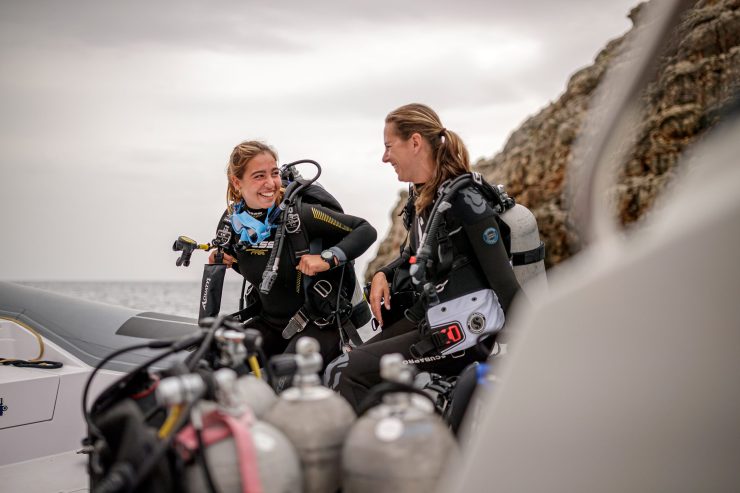

One thing many female divers notice is that repetitive dive schedules can feel more physically demanding during certain parts of the menstrual cycle. Now, readers, this is a good time to remind you that women are half the population. Of course we all experience life differently and not all of us worry about physically demanding jobs while on our period, or otherwise fot that matter. But for those that do, this if for you.
A typical dive day may involve:
- Early mornings
- Heat exposure
- Carrying equipment
- Climbing boat ladders
- Saltwater dehydration
- Seasickness
- Multiple dives
- Long surface intervals in the sun
Even experienced divers can feel more tired than usual.
The important thing is not to treat exhaustion as something to “push through” unnecessarily.
Resting a dive, shortening a dive day, or choosing easier profiles when feeling depleted is not weakness — it’s good judgement.
Experienced divers understand that listening to the body is part of diving safely.
Hydration Matters More Than Most Divers Realize
Dehydration is already one of the most overlooked issues in recreational diving.
Add tropical heat, caffeine, seasickness, alcohol from the night before, repetitive diving, and hormonal changes that may affect fluid retention or bloating, and hydration becomes even more important.
Many women report that staying well hydrated helps reduce:
- Cramping
- Fatigue
- Headaches
- General discomfort
A good rule during dive trips is:
drink more water than you think you need.
Especially in warm destinations like Mexico, Thailand, Indonesia, Costa Rica, or the Philippines, dehydration can creep up very quickly between dives.
Electrolytes can also make a noticeable difference during long boat days.
Wetsuits, Bloating and Body Confidence

This is something many women quietly deal with but rarely discuss openly.
Hormonal fluctuations can sometimes cause bloating or water retention, which can make already-tight wetsuits feel noticeably more uncomfortable.
And unfortunately, wetsuits are not known for their forgiveness.
A few practical things can help:
- Allow extra time to gear up comfortably
- Stay hydrated
- Rinse wetsuits with cool water before putting them on in hot climates
- Wear whatever exposure protection feels physically comfortable rather than overly “flattering”
One thing worth remembering is that dive boats bring together people of every shape, size and age. The underwater world is not reserved for one body type, and confidence underwater has very little to do with aesthetics.
Comfort and functionality matter far more than appearance.
Best Period Products for Diving

Every woman has different preferences because, shock horror! Women are actually all very different in mind and body. But, there are a few options commonly used in diving.
Tampons
Tampons a good choice for scuba diving, although now we are learning about their toxic qualities. Do you research properly on this one.
Most women find them perfectly effective underwater, but the key is to change them regularly between dives and, depending on the boat, this may or may not be an easy acheivement.
Helpful tips include:
- Change before and after diving
- Bring spare supplies in a waterproof pouch
- Avoid leaving one in all day during repetitive dive schedules
Water pressure generally prevents leakage while underwater itself.
AT CABO PRIVATE GUIDE WE HAVE TAMPONS AVAILABLE FREE OF CHARGE IN ALL OF THE BATHROOMS. HELP YOURSELF!
Menstrual Cups
Many experienced divers (myself included) and liveaboard travellers prefer menstrual cups because they:
- Last longer between changes
- Create less waste
- Work well during multi-dive days
- Are practical in remote locations
However, they can involve a learning curve to figure out the correct size and style for your body, so it’s best not to test one for the first time during an intensive dive trip.
AT CABO PRIVATE GUIDE, WE HAVE THESE FOR SALE. ASK AT THE DESK OR PREORDER VIA WHATSAPP. LIMITED SIZES AVAILABLE
Dive Boat Reality: Be Prepared
Dive boats are not always designed with women in mind.
Bathrooms may be small or… in the ocean!
Privacy can be limited.
Changing space may be minimal if at all
Bins are not always available.
A little preparation makes a huge difference.
Many experienced female divers keep a small “boat essentials kit” with:
- Period products
- Baby wipes
- Spare bikini bottoms
- Pain relief
- Electrolytes
- Hand sanitizer
- Ziplock bags
- Dry underwear
It sounds simple, but having supplies organized removes a surprising amount of stress during long dive days.
Younger Divers and Open Conversations
Teenage girls and younger women often feel particularly anxious about menstruation during dive courses or dive holidays.
They may worry about:
- Leaking
- Wetsuits
- Talking to instructors
- Boat bathrooms
- Being embarrassed
- Managing periods during certification dives
This is where experienced dive professionals can make an enormous difference.
The more normalized these conversations become, the more comfortable and confident young female divers feel entering the sport.
Periods are not unusual underwater.
They are simply part of life for many divers.
Final Thoughts
One of the most valuable lessons diving teaches is respect for conditions — and sometimes those conditions include our own bodies.
For most women, diving on a period is completely manageable and perfectly safe. The key is approaching it with preparation, self-awareness, and a little flexibility. If you are signed up to dive with us at Cabo Private Guide, or our affiliate shark diving service Dive Gordo Banks, and you would like to understand how to manage this time of the month on our boats, just send a message and ask to speak to one of our female dive guides.
There is still much we do not fully understand about female-specific dive physiology, particularly regarding hormones and decompression research. Hopefully, that changes in the coming years as more women enter both the diving industry and dive medicine research itself.
Until then, practical experience still counts for a great deal.
The overwhelming reality from female divers around the world is this:
women continue to dive safely, professionally, confidently and successfully throughout every phase of life — including during menstruation.
And ultimately, the ocean does not ask whether a diver is on her period.
It simply asks whether she is prepared, comfortable, and ready to dive safely.
